
GLP1s
The Complete GLP1 Guide
.png?width=48&height=48&name=Untitled%20design%20(23).png)
TribElle Clinical Team
Reviewed by Julie Boora, Superintendent Pharmacist, TribElle Health Ltd (GPhC Reg. 9012688)
Weight management · Choosing a treatment
Mounjaro, Wegovy or Foundayo: your complete guide to GLP-1s in the UK
Everything you need to know to feel confident about selecting the right treatment for you.
In this guide we'll share detailed information on the current GLP-1s available in the UK; Mounjaro, Wegovy and Foundayo so you have everything you need to know and feel confident about selecting the right treatment for you.
The following information highlights the key differences between the GLP-1s as they are not all interchangeable so use this guide to pick the right one for you.
Jump to a section
This is a long guide — tap what you need and jump straight there.
Start here
Results
Getting started
Side effects
Staying on track
Tablets & switching
Women’s health
Other medicines
Which GLP-1 suits me? Answer 3 questions
1 · How would you prefer to take it?
2 · Could you manage a fasting routine? (empty stomach, then a 30-minute wait before food or drink)
3 · What matters most to you?
Your match
Start your consultation →This is a starting point, not a prescription. A qualified prescriber will confirm which treatment is clinically appropriate for you.
Answer the three questions above to see your match.
1. What are GLP-1s and how do GLP-1s work?
Mounjaro (Tirzepatide), Wegovy (Semaglutide) and Foundayo (Orforglipron) are all GLP-1 receptor agonists.
GLP-1 stands for glucagon-like peptide-1, which is a hormone naturally produced by our body in our gut as a response to food.
What happens when a GLP-1 medicine activates the GLP-1 receptor?
The GLP-1 receptor is a type of G-protein-coupled receptor (GPCR) found in several tissues, including the pancreas and areas of the brain involved in appetite regulation.
When a GLP-1 medicine binds to the receptor, it activates a signalling pathway inside the cell. This increases a chemical messenger called cyclic AMP (cAMP), which helps transmit the signal and trigger a series of cellular responses.
The result is a coordinated effect on blood glucose, digestion and appetite:
01
More insulin when it’s needed
Helps pancreatic beta cells release insulin in response to higher blood glucose levels.
02
Less glucagon
Reduces the release of glucagon, a hormone that raises blood glucose.
03
Slower stomach emptying
Food moves from the stomach into the small intestine more slowly, so you feel fuller for longer.
04
Reduced appetite
Acts on appetite centres in the brain, reducing hunger and increasing feelings of fullness.
How does the GIP part of tirzepatide work?
Tirzepatide is a dual GIP and GLP-1 receptor agonist. This means it activates two different incretin hormone receptors rather than targeting GLP-1 alone.
GIP stands for glucose-dependent insulinotropic polypeptide. It is a naturally occurring hormone released mainly from the small intestine after eating. GIP receptors are also found in parts of the brain involved in appetite and food intake.
Research suggests that activating GIP receptors alongside GLP-1 receptors may contribute to tirzepatide's effects on appetite and calorie intake. However, scientists are still investigating exactly how much of tirzepatide's weight-loss effect comes specifically from GIP receptor activation.
In short: tirzepatide switches on two related metabolic signalling systems rather than one.
The GLP-1 pathway helps regulate appetite, fullness, digestion and blood glucose.
The GIP pathway helps the body respond to food, particularly by enhancing glucose-dependent insulin secretion, while also interacting with pathways involved in appetite and energy regulation.
Tirzepatide activates both pathways, which is why it is described as a dual GIP/GLP-1 receptor agonist.
2. How do they help weight loss?
GLP-1 medications mimic the natural hormone GLP-1 which is released after eating to:
→Reduce hunger signals and help you feel less driven to eat
→Increase satiety, so smaller meals feel more satisfying
→Slow stomach emptying, which can prolong fullness after meals
→Help regulate blood sugar levels
→Reduce cravings and food noise for many users
Why do GLP-1 medicines last longer than natural GLP-1?
Natural GLP-1 is broken down rapidly by enzymes in the body, including DPP-4 (dipeptidyl peptidase-4). Medicines such as semaglutide have been specifically designed to resist rapid breakdown and remain active in the body for much longer.
This is why Wegovy and Mounjaro are taken once a week, rather than needing to be taken every few minutes or hours like the body's naturally produced GLP-1.
3. What is the difference between Mounjaro, Wegovy and Foundayo?
| Mounjaro Pen | Wegovy Pen | Wegovy Tablets | Foundayo Tablets | |
|---|---|---|---|---|
| Active ingredient | Tirzepatide | Semaglutide | Semaglutide | Orforglipron |
| How it's taken | Injection, weekly | Injection, weekly | Oral, daily | Oral, daily |
| Food & drink | No food or drink restrictions | No food or drink restrictions | Take on an empty stomach with a sip of water, and nothing for 30 mins afterwards | No food or drink restrictions |
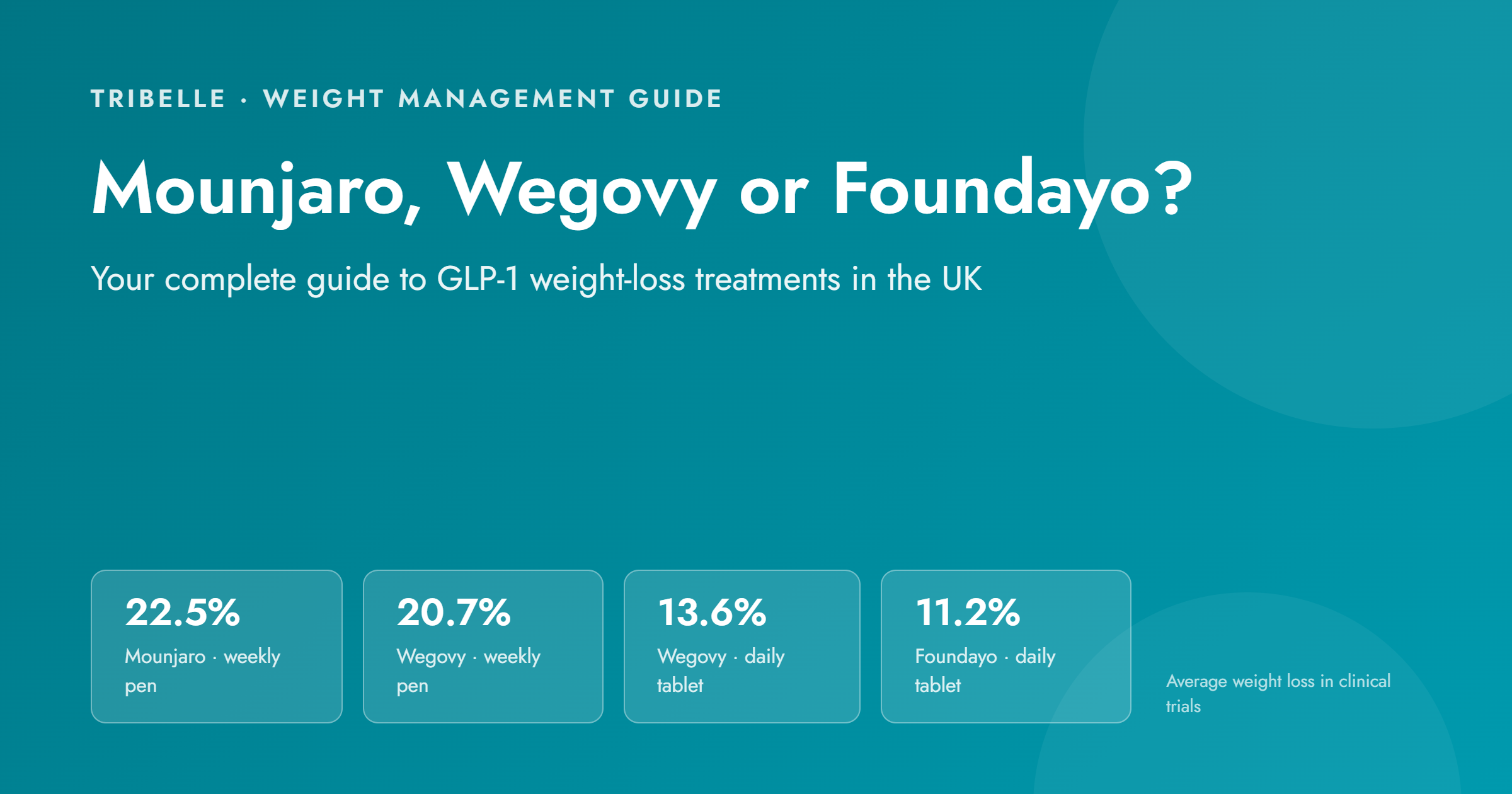
| Average weight loss from trials | 20.9–22.5% in 72 weeks at the highest dose | 20.7% in 72 weeks at the highest dose | 13.6% at the highest dose after 64 weeks | 11.2% at the highest dose for 72 weeks |
| Very common side effects | Nausea, constipation, diarrhoea, vomiting, headaches | Nausea, constipation, diarrhoea, vomiting, headaches | Nausea, constipation, diarrhoea, vomiting, headaches | Nausea, constipation, diarrhoea, vomiting, headaches |
| Titration doses | 2.5 mg → 5 mg → 7.5 mg → 10 mg → 12.5 mg → 15 mg weekly | 0.25 mg → 0.5 mg → 1 mg → 1.7 mg → 2.4 mg weekly (up to 7.2 mg if appropriate) | 1.5 mg → 4 mg → 9 mg → 25 mg daily | 0.8 mg daily, increased gradually (at least 30 days per step) to a maximum of 17.2 mg |
| Storage | Fridge | Fridge | Room temperature | Room temperature |
| Quantity per pack | 4 injection doses | 4 injection doses | 30 tablets | 30 tablets |
Average weight loss in trials, at the highest dose
Mounjaro Pen
22.5% Wegovy Pen
20.7% Wegovy Tablets
13.6% Foundayo Tablets
11.2%
Mounjaro shown at 22.5% (SURMOUNT-1 range 20.9–22.5%). Trial durations differ: 72 weeks except Wegovy Tablets (64 weeks).
Trial averages come from different studies and are not directly comparable; they are not a guarantee of individual results. Details and sources below.
4. How much weight can I lose with Mounjaro?
In clinical trials, people taking Mounjaro (tirzepatide) lost an average of up to 20.9% of their starting body weight after 72 weeks at the 15 mg dose. Lower doses were also effective, with average weight loss of 15.0% with 5 mg and 19.5% with 10 mg. These results came from the Phase 3 SURMOUNT-1 trial, which included 2,539 adults with obesity or overweight plus a weight-related health condition, but without diabetes. Participants received once-weekly tirzepatide alongside diet and physical-activity advice.
At the highest 15 mg dose, 83.5% of participants lost at least 10% of their body weight, 70.6% lost at least 15%, and 56.7% lost at least 20% after 72 weeks. The average starting weight was 104.8 kg, meaning that a 20.9% reduction would equate to approximately 21.9 kg (48 lb) for someone starting at that average weight. However, individual results vary and clinical-trial averages should not be interpreted as a guarantee of how much weight one person will lose.
Mounjaro 15 mg: how many people reached each milestone (72 weeks)
Lost ≥ 10%
83.5% Lost ≥ 15%
70.6% Lost ≥ 20%
56.7%
Share of SURMOUNT-1 participants on tirzepatide 15 mg reaching each weight-loss threshold.
Clinical trial reference: Jastreboff AM, Aronne LJ, Ahmad NN, et al. Tirzepatide Once Weekly for the Treatment of Obesity. New England Journal of Medicine. 2022;387:205–216. doi:10.1056/NEJMoa2206038. Read the SURMOUNT-1 trial
How much weight can I lose with Wegovy injections?
In the 72-week STEP UP clinical trial, people taking the higher 7.2 mg dose of injectable Wegovy (semaglutide) lost an average of 20.7% of their body weight. This was compared with 17.5% with semaglutide 2.4 mg and 2.4% with placebo. Participants had obesity but did not have type 2 diabetes, and all treatment groups also received lifestyle intervention.
For someone weighing around 113 kg (17 st 11 lb) at the start of treatment, the average 20.7% weight loss seen with semaglutide 7.2 mg would be equivalent to approximately 23 kg (3 st 9 lb) over 72 weeks. However, this is an average from a clinical trial and should not be interpreted as a prediction of how much weight an individual will lose.
Clinical trial reference: Wharton S, et al. Once-Weekly Semaglutide 7.2 mg in Adults with Overweight or Obesity: The STEP UP Trial. The Lancet Diabetes & Endocrinology. 2025. doi: 10.1016/S2213-8587(25)00226-8. Novo Nordisk announcement · EASD presentation
How much weight can I lose with Wegovy tablets?
In the OASIS 4 clinical trial, once-daily oral semaglutide 25 mg resulted in an average weight loss of 13.6% after 64 weeks. This trial investigated oral semaglutide in 307 adults with overweight or obesity who did not have diabetes. Participants took a once-daily tablet alongside diet and physical-activity intervention.
At week 64, average weight loss was 13.6% with oral semaglutide 25 mg compared with 2.2% with placebo. Almost half of participants (47.0%) achieved at least 15% weight loss, while 27.5% achieved at least 20% weight loss. The average starting weight was approximately 106 kg, so the 13.6% average reduction corresponds to around 14.2 kg (31 lb).
These results come from OASIS 4, a Phase 3 randomised, double-blind, placebo-controlled trial. As with injectable weight-management medicines, the amount of weight an individual loses can vary considerably.
Clinical trial reference: Wharton S, Lingvay I, Bogdanski P, et al. Oral Semaglutide at a Dose of 25 mg in Adults with Overweight or Obesity. New England Journal of Medicine. 2025;393:1077–1087. doi:10.1056/NEJMoa2500969. Read the OASIS 4 trial · PubMed · Wegovy tablets SmPC
How much weight can I lose with Foundayo tablets?
In the Phase 3 ATTAIN-1 trial, people taking orforglipron (the active ingredient in Foundayo) lost an average of up to 11.2% of their starting body weight after 72 weeks at the 36 mg dose. Orforglipron is a once-daily oral GLP-1 receptor agonist. The trial included 3,127 adults with obesity without diabetes, who received orforglipron at 6 mg, 12 mg or 36 mg, or placebo, alongside healthy diet and physical activity.
Average weight loss after 72 weeks was 7.5% with 6 mg, 8.4% with 12 mg and 11.2% with 36 mg, compared with 2.1% with placebo. At the highest dose, 54.6% of participants lost at least 10% of their body weight, 36.0% lost at least 15%, and 18.4% lost at least 20%.
Clinical trial reference: Wharton S, Aronne LJ, Stefanski A, et al. Orforglipron, an Oral Small-Molecule GLP-1 Receptor Agonist for Obesity Treatment. New England Journal of Medicine. 2025;393:1796–1806. doi:10.1056/NEJMoa2511774. ATTAIN-1, ClinicalTrials.gov NCT05869903. Read the ATTAIN-1 trial · PubMed
5. How long does it take for GLP-1 medicines to start working?
GLP-1 medicines can begin affecting appetite and food intake soon after starting treatment, but noticeable weight loss usually develops gradually over several weeks and months. The amount and speed of weight loss varies between individuals and depends on the medicine, dose, treatment duration, diet, activity levels and how your body responds.
Mounjaro (tirzepatide) and Wegovy injection (semaglutide) are started at a low dose and gradually increased. This means the starting dose is primarily designed to help your body adjust to treatment rather than produce maximum weight loss. The dose is increased over time if appropriate and tolerated.
Wegovy tablets (oral semaglutide) are also gradually titrated to the maintenance dose. Clinical trials show that weight loss continues over many months rather than occurring entirely at the beginning of treatment. In the OASIS 4 trial, oral semaglutide 25 mg produced an average weight loss of 13.6% after 64 weeks.
Foundayo (orforglipron) is a once-daily oral GLP-1 receptor agonist that is also gradually dose-escalated. In the Phase 3 ATTAIN-1 trial, people taking orforglipron (the active ingredient in Foundayo) lost an average of up to 11.2% of their starting body weight after 72 weeks at the 36 mg dose.
The key message: GLP-1 medicines are not designed to produce maximum weight loss in the first few weeks. A gradual response is normal, particularly while your dose is being increased.
6. Will I lose weight in the first week of using a GLP-1 medicine?
You may lose some weight during the first week of treatment, but you should not expect a large or consistent amount of weight loss immediately.
Early changes on the scales can include changes in fluid levels, food intake and bowel movements, as well as actual changes in body fat. Your weight can also fluctuate from day to day, so looking at the trend over several weeks is much more useful than comparing individual days.
Mounjaro, Wegovy and Foundayo are intended for long-term weight management, and the clinical trials demonstrating their effectiveness measured weight loss over many months. For example, the SURMOUNT-1 trial assessed tirzepatide over 72 weeks, while STEP trials assessed semaglutide over many months.
If you do not lose weight in the first week, this does not mean the medication is not working. The more important measures are your longer-term weight trend, appetite, waist circumference, metabolic health and how well you tolerate treatment.
7. Who is eligible for GLP-1 weight loss medication?
Mounjaro, Wegovy injections, Wegovy tablets and Foundayo are prescription medicines used alongside a reduced-calorie diet and increased physical activity for adults who meet the clinical criteria for weight management. In the UK, the licensed criteria generally include adults with a BMI of 30 kg/m² or above, or adults with a BMI of 27 kg/m² or above who also have at least one weight-related health condition.
Eligibility is not based on BMI alone. A healthcare professional should consider your medical history, current medicines, previous attempts at weight management, eating patterns, health conditions and whether the treatment is clinically appropriate and safe for you. The criteria for NHS prescribing can be more restrictive than the licensed indication, so meeting the licence criteria does not automatically mean that treatment will be available through the NHS.
Source: Mounjaro SmPC
8. How do you use or take Mounjaro, Wegovy and Foundayo?
Mounjaro and Wegovy injection are once-weekly injections, while Wegovy tablets and Foundayo are taken once daily. All four medicines use gradual dose escalation to help your body adjust to treatment and reduce gastrointestinal side effects.
The dose journey at a glance
Mounjaro Pen · weekly
2.5 mg5 mg7.5 mg10 mg12.5 mg15 mg max
Wegovy Pen · weekly
0.25 mg0.5 mg1 mg1.7 mg2.4 mgup to 7.2 mg
Wegovy Tablets · daily
1.5 mg4 mg9 mg25 mg maintenance
Foundayo Tablets · daily
0.8 mggradual steps · ≥30 days each17.2 mg max
Mounjaro (tirzepatide) starts at 2.5 mg once weekly for four weeks, followed by 5 mg once weekly. If appropriate, the dose can then be increased in 2.5 mg increments, with at least four weeks between increases. The maximum dose is 15 mg once weekly.
You can find all the guidance needed on how to inject Mounjaro in this user manual.
Wegovy injection (semaglutide) is injected once weekly. The dose is gradually increased over several months. The standard maintenance dose is 2.4 mg once weekly; for adults with obesity, the dose may be increased to 7.2 mg once weekly if clinically appropriate and after at least four weeks on 2.4 mg.
You can find all the information needed on how to inject Wegovy in this patient information leaflet.
Wegovy tablets (oral semaglutide) are taken once daily. The dose starts at 1.5 mg daily and is increased monthly through 4 mg and 9 mg to the recommended 25 mg maintenance dose, if tolerated. The tablet should be taken on an empty stomach after at least eight hours of fasting, swallowed whole with up to 120 mL of water, and you should wait at least 30 minutes before eating, drinking or taking other oral medicines.
You can find all the information on how to take Wegovy tablets in this patient information leaflet.
Foundayo (orforglipron) is taken once daily and does not require fasting or special timing around meals. Treatment starts at 0.8 mg once daily for 30 days and is then increased gradually, with at least 30 days at each dose level. The maximum dose is 17.2 mg once daily.
You can find all the information on how to take Foundayo tablets in this patient information leaflet.
9. What are the side effects of GLP-1 medicines and are there any long-term effects?
The most common side effects of Mounjaro, Wegovy and Foundayo are gastrointestinal symptoms such as nausea, diarrhoea, constipation, vomiting, abdominal discomfort and reduced appetite. These effects are usually more noticeable when starting treatment or increasing the dose and are often mild to moderate.
Less common but potentially serious complications can include pancreatitis, gallbladder problems, dehydration and kidney problems related to severe gastrointestinal symptoms. GLP-1 medicines can also slow stomach emptying, so they may not be appropriate for people with certain gastrointestinal conditions. Mounjaro's UK product information, for example, advises caution in people with severe gastrointestinal disease, including severe gastroparesis.
There is an important difference between known long-term safety information and possible long-term effects that are still being studied. Tirzepatide and semaglutide now have substantial clinical-trial and real-world safety data, but Foundayo/orforglipron is a newer medicine and therefore has less long-term exposure data. The ATTAIN-1 trial found that the safety profile of orforglipron was consistent with the GLP-1 receptor agonist class, with gastrointestinal adverse effects being the most common.
For all four medicines, ongoing medical monitoring is important. If you develop severe or persistent abdominal pain, repeated vomiting, symptoms of dehydration, or other concerning symptoms, seek medical advice promptly.
Sources: SURMOUNT-1 · Mounjaro SmPC · ATTAIN-1
10. How long do GLP-1 side effects last?
For many people, nausea and other gastrointestinal symptoms improve over days to weeks, particularly once the body becomes accustomed to a stable dose. However, symptoms can return or become more noticeable after a dose increase.
If side effects are severe, persistent or preventing you from eating and drinking normally, speak to your prescriber. Do not increase your dose simply because you think you should be losing weight faster.
Seek urgent medical attention for severe or persistent abdominal pain, particularly if accompanied by vomiting, because this can be a sign of pancreatitis or another significant problem.
11. What cautions should I take before using a GLP-1 weight-loss medicine?
Before starting Mounjaro, Wegovy or Foundayo, your prescriber should check your medical history, other medicines, pregnancy plans and any conditions that could make treatment unsuitable or require additional monitoring.
Tell your healthcare professional if you have previously had pancreatitis, significant gastrointestinal disease or gastroparesis, gallbladder problems, kidney disease, liver disease or diabetic eye disease. Your other medicines are also important because GLP-1 medicines can affect gastric emptying and may alter the absorption or effect of some oral medicines.
If you take insulin or a sulfonylurea, your risk of low blood glucose may increase and your diabetes treatment may need adjustment.
Women who use oral contraception should pay particular attention to the product-specific advice. Tirzepatide can temporarily reduce exposure to oral contraceptives, so additional contraception or a non-oral method is recommended when starting treatment and after dose increases. Foundayo/orforglipron also has specific advice because it may reduce the effectiveness of oral hormonal contraceptives for 30 days after starting treatment and after each dose increase.
Sources: Wegovy tablets SmPC · Foundayo PIL
12. How can I get the most weight loss from Mounjaro, Wegovy or Foundayo?
The best way to maximise healthy weight loss is to combine the medication with a sustainable nutrition, activity and behaviour-change plan rather than relying on the medicine alone.
GLP-1 medicines work partly by reducing appetite and increasing feelings of fullness, which can make it easier to maintain a calorie deficit. However, taking a higher dose does not automatically mean you will lose more weight, and the highest dose is not necessarily the right dose for every person.
To support healthy weight loss, focus on:
✔Eating adequate protein to help preserve lean mass
✔Eating plenty of fibre-rich foods
✔Maintaining good hydration — drink lots of water
✔Including resistance exercise and regular physical activity
✔Eating slowly and responding to hunger and fullness cues
✔Limiting highly processed, energy-dense foods where appropriate
✔Taking your medication consistently and following the prescribed titration schedule
✔Managing constipation, nausea or other side effects early rather than allowing them to interfere with nutrition and hydration
Clinical trials demonstrate substantial average weight loss when these medicines are used alongside lifestyle intervention. For example, SURMOUNT-1 found average weight loss of up to 22.5% with tirzepatide 15 mg at 72 weeks, while ATTAIN-1 found 11.2% with orforglipron 36 mg at 72 weeks.
Sources: SURMOUNT-1 · ATTAIN-1
13. How can I keep the weight off after losing weight with GLP-1 medication?
Maintaining weight loss usually requires a long-term plan because obesity is a chronic condition and appetite-regulating mechanisms can return towards their previous state when medication is stopped.
A sustainable maintenance plan should include regular physical activity, adequate protein and fibre, a nutritionally balanced diet, sleep, behavioural support and ongoing monitoring of weight and health markers.
For some people, continuing weight-management medication is an appropriate part of long-term treatment. The evidence demonstrates why this matters. In SURMOUNT-4, people who continued tirzepatide after an initial 36-week treatment period maintained and extended their weight loss, while those switched to placebo regained substantial weight.
Maintenance therefore shouldn't be viewed simply as "reaching your target weight and stopping". It is about developing a sustainable strategy to protect the improvements you have achieved.
Source: SURMOUNT-4
14. What are the maintenance criteria for GLP-1 weight-loss medication?
There is no single target weight or treatment duration that applies to everyone; maintenance treatment should be reviewed according to your response, health benefits, side effects and individual circumstances.
NICE guidance provides an important practical benchmark for tirzepatide and semaglutide: if a person has lost less than 5% of their initial body weight after six months on treatment, clinicians should consider whether continuing treatment is appropriate because the potential benefits may not outweigh the risks.
For someone who has responded well, maintenance may involve continuing the medication at an appropriate tolerated dose alongside lifestyle measures. The aim is not necessarily to keep losing weight indefinitely; it may instead be to maintain a healthier weight and prevent clinically significant regain.
Maintenance should therefore be individualised rather than based solely on reaching a particular number on the scales.
Source: NICE guidance summary
15. Wegovy tablets: taking them correctly
Do I have to eat exactly 30 minutes after taking Wegovy tablets?
No. You do not have to eat exactly 30 minutes after taking Wegovy tablets. The instruction is to wait at least 30 minutes before eating, drinking or taking other oral medicines.
Wegovy tablets should be taken once daily on an empty stomach after at least eight hours of fasting. Swallow the tablet whole with a small amount of water, up to 120 mL, and then wait at least 30 minutes before eating, drinking or taking other oral medicines. Waiting less than 30 minutes reduces absorption of semaglutide.
Can I sip water overnight before taking my Wegovy tablet?
Ideally, no. The tablet should be taken after the recommended fasting period of at least eight hours. If you need to drink water overnight, follow the instructions provided with your prescription and speak to a TribElle pharmacist if this is difficult to achieve.
Can I drink coffee after taking Wegovy tablets?
Not during the 30-minute waiting period. Coffee counts as a drink, so wait at least 30 minutes after taking your tablet before drinking it. After that period, you can resume your normal drinks.
Can I drink Diet Coke after taking Wegovy tablets?
Not during the 30-minute waiting period. The same rule applies to Diet Coke, tea, juice and other drinks: wait at least 30 minutes after taking the tablet.
Can I drink wine while taking Wegovy tablets?
There is no specific requirement to completely avoid alcohol solely because you take oral semaglutide, but alcohol can worsen nausea, vomiting, dehydration and gastrointestinal symptoms. If you drink alcohol, moderation is particularly important if you are experiencing side effects.
What if the Wegovy tablet makes me gag?
Do not crush, chew or split the Wegovy tablet to make it easier to swallow. The tablet should be swallowed whole.
If the tablet consistently makes you gag or causes significant nausea, speak to your TribElle pharmacist rather than changing the tablet yourself.
Source: Wegovy tablets SmPC
16. Wegovy and Foundayo tablets: can I change the dose myself?
Can I cut Wegovy or Foundayo tablets in half if they are not working?
No. You should not cut, crush or alter Wegovy tablets, and you should not change the dose of Foundayo tablets yourself.
The UK Wegovy tablet information specifically states that the tablets should not be split, crushed or chewed, because it is not known whether doing so affects semaglutide absorption.
Foundayo tablets are also supplied in specific strengths as part of a planned dose-escalation schedule. The appropriate dose should be selected by your prescriber according to the licensed dosing schedule and your individual response and tolerability.
Can I take two tablets if one isn't working?
No. Never take two Wegovy or Foundayo tablets to try to make the medicine work faster or produce more weight loss.
If you feel that your current dose is no longer controlling your appetite or your weight loss has plateaued, speak to a TribElle Pharmacist. They can determine whether you should remain on the current dose, increase it according to the licensed schedule, or consider another approach.
More medication does not necessarily mean more weight loss and can increase the risk of side effects.
Sources: Wegovy tablets SmPC · Foundayo SmPC
17. What should I do if I am vomiting and cannot keep my GLP-1 medication down?
If you are repeatedly vomiting while taking a GLP-1 medicine, do not automatically take another dose to replace the one you think you have lost. Contact your prescriber or TribElle pharmacist for advice.
This is particularly important with injectable Mounjaro and Wegovy, because the medicine has already been administered and taking an additional injection could result in an excessive dose.
With Wegovy tablets and Foundayo, the situation can depend on when vomiting occurred and whether the tablet is likely to have been absorbed. Do not routinely take an extra tablet without professional advice.
The immediate priority is hydration. Take small, frequent sips of fluid if you can tolerate them. Persistent vomiting can cause dehydration and, in severe cases, kidney problems. The Wegovy tablet SmPC specifically warns about dehydration associated with gastrointestinal adverse reactions.
Seek urgent medical advice if you cannot keep fluids down, are passing very little urine, feel faint or confused, have severe abdominal pain, or have persistent vomiting.
Source: Wegovy tablets SmPC
18. Switching between GLP-1 medicines
Example: I am moving from 5 mg Mounjaro to 9 mg Wegovy tablets. Will my side effects be worse because I skipped the lower tablet doses?
Potentially, yes. Switching from Mounjaro to Wegovy tablets at a higher oral semaglutide dose without following the tablet's recommended dose-escalation schedule could increase the risk of gastrointestinal side effects.
This is because 5 mg of tirzepatide is not directly equivalent to 9 mg of oral semaglutide. The milligram strengths of different GLP-1 medicines cannot be compared directly.
Wegovy tablets are designed to be started at a low dose and increased gradually, allowing your body to adapt to semaglutide.
Therefore, if you are switching from Mounjaro to Wegovy tablets, your prescriber should determine the appropriate starting dose rather than simply matching the dose numbers.
You may also experience a different side-effect profile when switching because tirzepatide activates both GIP and GLP-1 receptors, whereas semaglutide activates the GLP-1 receptor.
Do not start Wegovy tablets at 9 mg simply because you previously tolerated 5 mg Mounjaro. Discuss the switch and appropriate titration schedule with your prescriber.
19. What happens when I stop taking Mounjaro, Wegovy or Foundayo?
Stopping a GLP-1 weight-management medicine can lead to increased appetite and weight regain, particularly if the medication is stopped without an ongoing weight-maintenance plan.
This is not because you have "failed". Obesity involves complex biological mechanisms that regulate appetite, hunger and energy balance, and these mechanisms do not necessarily disappear when weight has been lost.
The evidence is particularly clear with semaglutide. In the STEP 1 extension, participants who stopped semaglutide after 68 weeks regained an average of 11.6 percentage points of body weight during the following year, meaning they regained approximately two-thirds of their previous weight loss.
Tirzepatide shows a similar pattern. In SURMOUNT-4, participants who stopped tirzepatide and switched to placebo regained weight, while those who continued treatment lost an additional 5.5% on average during the following 52 weeks.
Foundayo is newer, so there is less long-term withdrawal evidence available than for semaglutide and tirzepatide. This is one reason why longer-term evidence for orforglipron will continue to be important.
Sources: STEP 1 extension · SURMOUNT-4 · ATTAIN-1
20. Can GLP-1 medicines help with weight gain during perimenopause?
GLP-1 medicines may help women manage weight gain and increased central adiposity during perimenopause, but they are not specifically a treatment for perimenopause itself.
During the menopause transition, changes in sex hormones, body composition, sleep, appetite, activity levels and insulin sensitivity can contribute to changes in weight and fat distribution. GLP-1 medicines can help with weight management by reducing appetite, increasing satiety and supporting a sustained reduction in energy intake.
However, there is currently much less research specifically in perimenopausal women than in the general population. A recent review concluded that GLP-1 receptor agonists may be useful for weight management in peri- and postmenopausal women, but highlighted the need for larger studies specifically in this population.
For women experiencing perimenopausal weight gain, treatment should therefore consider the whole picture, including nutrition, resistance training, sleep, cardiovascular risk, menopausal symptoms and whether HRT or other treatments are appropriate.
Source: Review: GLP-1 RAs in peri- and postmenopausal women
21. Do Wegovy tablets work during menopause?
Wegovy tablets can be used for weight management in eligible women during and after menopause, but menopause does not mean that everyone will respond in the same way.
During perimenopause and menopause, changes in oestrogen, body composition, appetite, sleep, activity levels and insulin sensitivity can make weight management more challenging. Semaglutide can support weight loss by reducing appetite and increasing feelings of fullness, but it does not treat menopause itself.
There is currently less clinical-trial evidence specifically focused on menopausal women than on the broader population with overweight or obesity. Treatment should therefore be considered as part of a wider menopause and weight-management plan, including nutrition, resistance exercise, sleep and appropriate management of menopausal symptoms.
22. Can I take Wegovy tablets with HRT?
Wegovy tablets are not automatically incompatible with HRT, but your prescriber should review your full medication list before starting treatment.
One reason is that oral semaglutide can delay gastric emptying and potentially affect the absorption of other oral medicines. The Wegovy tablet SmPC contains specific advice about taking other oral medicines after the 30-minute waiting period.
If your HRT is transdermal, such as an oestrogen patch, gel or spray, this issue is less relevant because the oestrogen is absorbed through the skin. However, if you take oral HRT, your prescriber or pharmacist should review how and when you take it.
23. Can I take Wegovy tablets with thyroid medication?
Yes, Wegovy tablets can be taken with levothyroxine, but your thyroid function may need monitoring. The Wegovy tablet prescribing information reports that exposure to thyroxine increased by 33% when levothyroxine was taken with oral semaglutide. Your doctor may therefore monitor your thyroid blood tests, particularly when starting or changing treatment.
Importantly, Wegovy tablets should not be taken at the same time as levothyroxine. After taking your Wegovy tablet, you should wait at least 30 minutes before taking other oral medicines. This is because taking other tablets too soon can reduce the absorption of semaglutide.
If you take levothyroxine every morning, speak to your TribElle pharmacist or prescriber about the best way to arrange the timing of both medicines.
Source: Wegovy tablets SmPC
24. Can I take Wegovy tablets with warfarin?
Yes, but if you take warfarin or another coumarin anticoagulant, you may need more frequent blood tests when starting Wegovy tablets.
Although clinical studies did not find a clinically relevant change in warfarin exposure or INR following semaglutide administration, cases of decreased INR have been reported with concomitant use of semaglutide and acenocoumarol. The Wegovy prescribing information therefore recommends frequent INR monitoring when semaglutide is started in people taking warfarin or other coumarin derivatives.
If you take an anticoagulant, do not stop or alter your dose yourself.
25. Can I take Wegovy tablets with the contraceptive pill?
Clinical studies found no clinically relevant change in the exposure of commonly studied oral contraceptives containing ethinylestradiol and levonorgestrel when taken with oral semaglutide.
However, vomiting or severe diarrhoea can reduce the effectiveness of an oral contraceptive, irrespective of the Wegovy interaction itself. If you experience significant gastrointestinal symptoms while taking the contraceptive pill, follow the missed-pill guidance for your particular contraceptive.
26. Can I take Wegovy tablets with diabetes medicines?
Wegovy tablets can be used alongside some diabetes medicines, but your diabetes treatment may need monitoring or adjustment.
The risk of hypoglycaemia (low blood sugar) can increase when semaglutide is used with insulin or medicines such as sulfonylureas. Your prescriber may therefore reduce the dose of these medicines when starting Wegovy.
Clinical interaction studies have not identified clinically relevant changes in exposure to metformin, although your overall diabetes treatment should still be monitored.
27. What about statins, digoxin or other medicines?
Wegovy tablets can be taken with many commonly prescribed medicines, and clinical studies have not identified clinically relevant interactions with several medicines including digoxin, metformin and furosemide.
There was an increase in exposure to rosuvastatin of approximately 41%, but this was not considered clinically relevant because rosuvastatin has a wide therapeutic index.
However, the important principle with Wegovy tablets is that semaglutide can affect the absorption of oral medicines. This is particularly relevant for medicines where small changes in blood concentrations could have important clinical consequences or where rapid absorption is essential.
28. Can I take Wegovy tablets with other GLP-1 medicines?
No. Wegovy tablets should not be taken alongside another semaglutide-containing medicine or another GLP-1 receptor agonist unless specifically directed by an appropriate specialist.
This includes medicines such as Mounjaro (tirzepatide), Wegovy injection (semaglutide) and other GLP-1 receptor agonists. Combining weight-loss medicines yourself can increase the risk of adverse effects without necessarily providing additional benefit. The Wegovy product information does not recommend co-administration with other semaglutide-containing products or GLP-1 receptor agonists.
29. Can GLP-1 medicines help with weight gain and symptoms associated with PMOS?
GLP-1 medicines can be considered for weight management in adults with PMOS who have overweight or obesity, but they are not currently a specific cure for PMOS.
The 2023 international evidence-based guideline states that anti-obesity medicines, including semaglutide and other GLP-1 receptor agonists, can be considered alongside lifestyle intervention for managing higher weight in adults with PMOS, following general population recommendations.
Weight loss can be particularly relevant in PMOS because higher weight and insulin resistance can contribute to the metabolic features of the condition. Clinical evidence suggests that anti-obesity medicines can improve anthropometric outcomes in women with PMOS, although the evidence base remains smaller than the large obesity trials conducted in the general population.
It is important to distinguish treating weight from treating PMOS itself. A GLP-1 medicine may help with weight and associated metabolic health, but it should not be assumed to treat every feature of PMOS, such as irregular periods, excess hair growth or fertility problems.
Because pregnancy safety data are limited, the international guideline recommends effective contraception when GLP-1 medicines are used and pregnancy is possible.
Sources: 2023 international guideline · Anti-obesity medicines evidence review
30. Can I take Mounjaro, Wegovy or Foundayo if I want to get pregnant soon?
No. Mounjaro, Wegovy and Foundayo should not be used during pregnancy, and if you are planning a pregnancy you should discuss stopping treatment with your prescriber well in advance.
The medicines have different recommended washout periods before a planned pregnancy:
→Mounjaro (tirzepatide): discontinue at least 1 month before a planned pregnancy.
→Wegovy (semaglutide): discontinue at least 2 months before a planned pregnancy because of its long half-life.
→Foundayo (orforglipron): discontinue at least 3 weeks before a planned pregnancy.
→Wegovy tablets (oral semaglutide): the UK product information advises stopping semaglutide if pregnancy occurs or is planned; because the active ingredient is semaglutide, the two-month pre-pregnancy interval used for semaglutide should be followed.
The washout clock: stop this long before trying to conceive
Foundayo
3 weeks Mounjaro
1 month Wegovy (pen & tabs)
2 months
Minimum recommended interval between the last dose and a planned pregnancy.
If you are thinking about pregnancy in the near future, tell your prescriber before starting a GLP-1 medicine rather than starting treatment and stopping it later. Effective contraception is recommended while using these medicines when pregnancy is possible.
This is particularly important with PMOS because weight loss can sometimes improve ovulation and fertility. You may become pregnant sooner than expected, so contraception remains important even if your periods have previously been irregular.
Are GLP-1 medicines right for you?
Mounjaro, Wegovy injections, Wegovy tablets and Foundayo can be highly effective medicines for weight management, but the right treatment depends on your BMI, health history, other medicines, pregnancy plans, treatment goals and how you respond to treatment. They work best as part of a long-term weight-management plan, rather than as a short-term solution. A qualified healthcare professional should assess whether treatment is appropriate and help you decide how to start, monitor, maintain and eventually stop treatment safely.
Ready to find the right treatment for you?
Start a free online consultation and a TribElle prescriber will assess which GLP-1 medicine is clinically appropriate for you.
Start your weight-loss consultation →© TribElle Health Ltd · GPhC Registration 9012688 · tribelle.co.uk · This content is for informational purposes only. Always read the patient information leaflet and consult a qualified healthcare professional.